Symptoms, Stages and Treatment

Senior Consultant Vascular & Endovascular Surgeon
MBBS (Singapore), MMed (Surgery), FRCSEd (General Surgery)
Special interest in minimally invasive vascular, endovascular and endovenous surgery
Medically reviewed by Dr Tay Jia Sheng
Table of Contents
Chronic venous insufficiency is a long term condition in which the veins in the legs cannot return blood to the heart properly, so blood pools in the lower legs.
Doctors call this backward flow venous reflux. Over months and years, the pooled blood raises the pressure inside the leg veins, a state known as venous hypertension. This raised pressure causes the swelling, discomfort and skin changes that mark the condition. CVI belongs to a wider group of vein problems known as venous disease, which also includes spider veins and varicose veins.
Vascular surgeons usually use the term CVI for the more advanced stages, when the leg has started to swell or the skin has started to change.
Healthy leg veins move blood upwards with the help of one way valves and the squeezing action of the calf muscles.
The legs have three connected vein systems: superficial veins just under the skin, deep veins within the muscles and perforator veins that link the two. Each time you walk, the calf muscles squeeze the deep veins and push blood towards the heart. This is often called the calf muscle pump.
Small valves inside the veins then close to stop blood falling back down. In CVI, some of these valves no longer close fully, or a vein has become narrowed or blocked. Blood then flows back towards the feet each time the calf muscle relaxes.
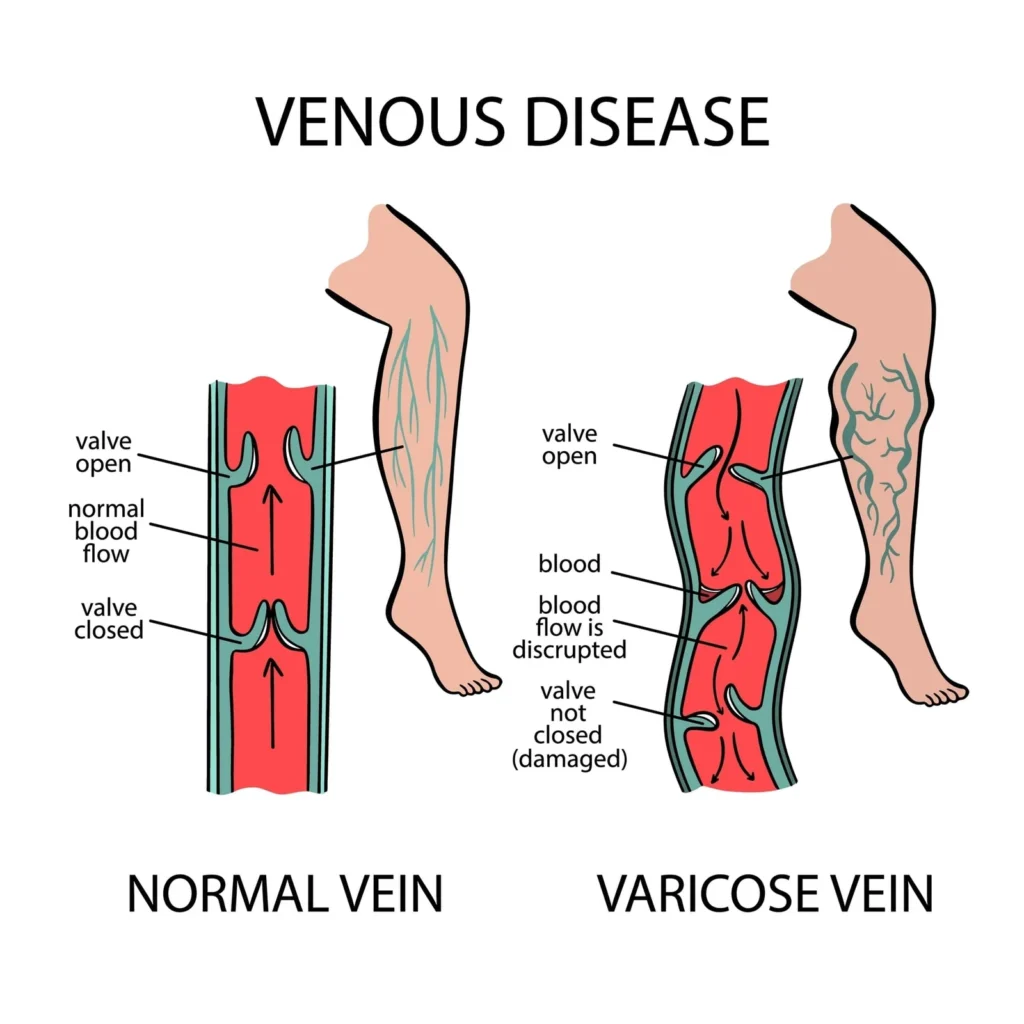

Healthy leg veins move blood upwards with the help of one way valves and the squeezing action of the calf muscles.
The legs have three connected vein systems: superficial veins just under the skin, deep veins within the muscles and perforator veins that link the two. Each time you walk, the calf muscles squeeze the deep veins and push blood towards the heart. This is often called the calf muscle pump.
Small valves inside the veins then close to stop blood falling back down. In CVI, some of these valves no longer close fully, or a vein has become narrowed or blocked. Blood then flows back towards the feet each time the calf muscle relaxes.

Dr Tay Jia Sheng is a distinguished vascular surgeon in Singapore, specialising in minimally invasive vascular, endovascular and endovenous procedures. He treats a broad range of conditions including varicose veins, deep vein thrombosis, peripheral arterial disease, diabetic foot ulcers and aortic aneurysms.
As a founding vascular surgeon at Sengkang General Hospital, Dr Tay led one of Singapore’s busiest vascular units with strong outcomes and low complication rates. He is among the few local surgeons skilled in advanced techniques such as minimally invasive vein harvesting and complex endovascular aneurysm repairs.
Outside the operating theatre, he has taught at Yong Loo Lin, Duke-NUS and Lee Kong Chian medical schools. Recognised with awards such as the SingHealth Quality Service Award and COVID-19 Resilience Medal, he now practises at Spectrum Vascular & General Surgery, offering patient-centred care with a focus on minimally invasive treatment.
Varicose veins are a visible sign of vein disease and DVT is a blood clot in a deep vein. CVI is the long term effect of poor blood return on the lower leg, and it can follow either one.
These conditions overlap, which is why they are often confused. The table below sets out the main differences.
| Condition | What it is | Typical signs | How it develops |
|---|---|---|---|
| Chronic venous disease | The umbrella term for long term vein problems in the legs | Ranges from spider veins to leg ulcers | Over years |
| Varicose Veins | Swollen, twisted surface veins caused by leaking valves | Bulging veins, aching, heaviness | Over years |
| Chronic venous insufficiency (CVI) | Raised vein pressure that affects the whole lower leg | Ankle swelling, skin discolouration, eczema, ulcers | Over months or years |
| Deep vein thrombosis | A blood clot in a deep vein, usually in the calf or thigh | Sudden pain, swelling and warmth in one leg | Over hours or days |
| Post thrombotic syndrome | A form of CVI caused by valve damage after a DVT | Ongoing swelling, heaviness and skin changes in the leg that had the clot | Months to years after a DVT |
| Lymphoedema | Swelling caused by poor drainage of lymph fluid, not by the veins | Firm swelling that can include the toes | Gradually |
CVI develops slowly. Sudden pain and swelling in one leg can be a sign of a blood clot and needs a medical assessment the same day.
The main symptoms of chronic venous insufficiency are swelling around the ankles, heavy or aching legs and changes in the skin of the lower legs.
Symptoms tend to build slowly. They are often worse at the end of the day or after long periods of standing or sitting, and they usually ease when you raise your legs.

Chronic venous insufficiency is caused by raised pressure in the leg veins, which happens when vein valves leak or when a vein is narrowed or blocked.
Doctors group the causes into primary and secondary CVI. A review in StatPearls (2026) estimates that about 70% of cases are primary and about 30% are secondary.
Primary CVI develops when the vein wall and valves weaken over time without an earlier injury. The vein stretches and the valve leaflets no longer meet. Blood then leaks backwards and the pressure in the lower leg rises.
Varicose veins that are left untreated can progress to CVI in some people, which is one reason they are worth having assessed.
Secondary CVI follows damage to the veins, most often from a deep vein thrombosis (DVT). As a clot clears, it can scar the valves or leave the vein partly narrowed. Long term swelling and skin changes of this kind are known as post thrombotic syndrome after deep vein thrombosis.
Leg injuries and previous leg surgery can also damage the veins. Less often, the valves are missing or malformed from birth.
Your risk of chronic venous insufficiency is higher if you are older, have a family history of vein problems or have had a blood clot in the leg.
Recognised risk factors include:
Work that keeps you on your feet for long hours, such as retail, nursing and hospitality, adds strain on the leg veins over the years.
Vascular specialists grade vein disease from C0 to C6 using the CEAP classification, and CVI covers the more advanced classes, from C3 to C6.
CEAP stands for Clinical, Etiological, Anatomical and Pathophysiological. The clinical class (C) describes what the doctor can see on your leg. The classification was last updated in 2020.
| CEAP class | What it means | What you may notice |
|---|---|---|
| C0 | No visible signs of vein disease | Symptoms such as heaviness may still be present |
| C1 | Spider veins or reticular veins | Fine red, blue or purple veins near the skin surface |
| C2 | Varicose veins | Bulging veins 3 mm or wider when standing |
| C3 | Swelling (oedema) | Ankle swelling that is worse at the end of the day |
| C4 | Skin changes | C4a: brown discolouration or eczema. C4b: hard, tight skin (lipodermatosclerosis) or white scarred patches (atrophie blanche). C4c: a fan of small veins around the ankle (corona phlebectatica) |
| C5 | Healed venous ulcer | A scar where a leg ulcer has healed |
| C6 | Active venous ulcer | An open wound, usually above the inner ankle |
Severe CVI usually refers to classes C5 and C6, when the skin has broken down into an ulcer. Not everyone moves through every class, and many people stay at the same stage for years. The letter “r” is added for varicose veins or ulcers that have come back after treatment (C2r and C6r).
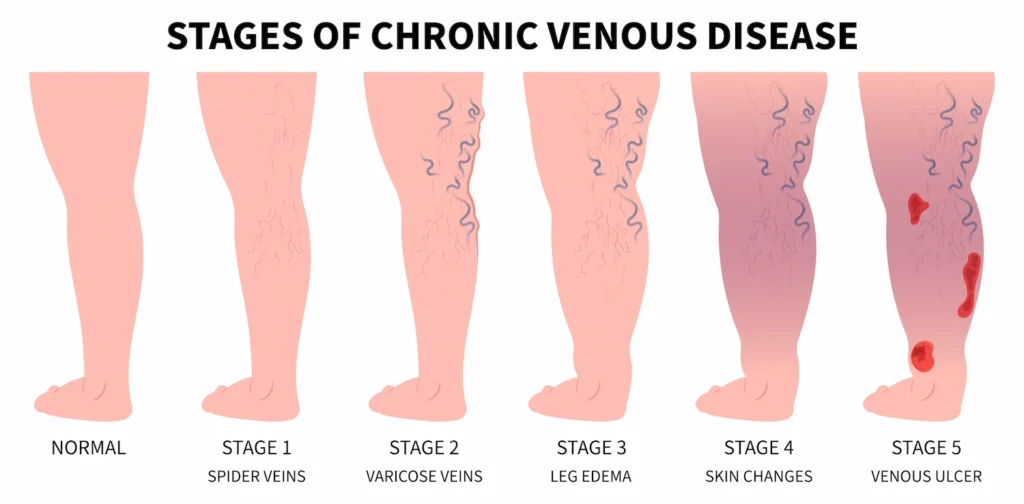

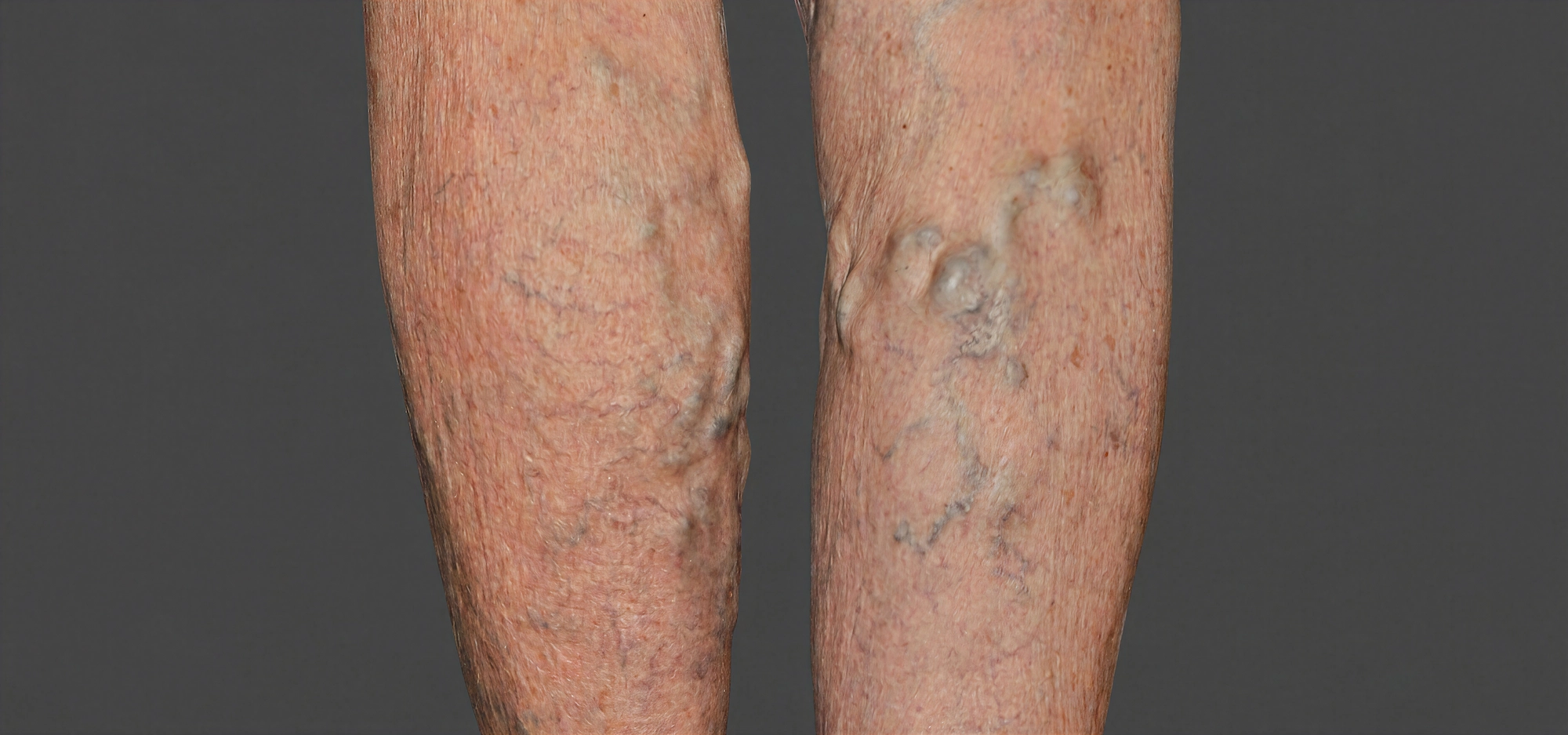
Without treatment, chronic venous insufficiency often worsens slowly, and the skin of the lower leg can become damaged and prone to wounds.
CVI is not usually life threatening. Over time, the raised pressure in the veins can lead to:
Ulcers are the complication that most affects daily life. Our page on venous leg ulcers explains how they are treated. Early assessment aims to protect the skin before these changes develop.
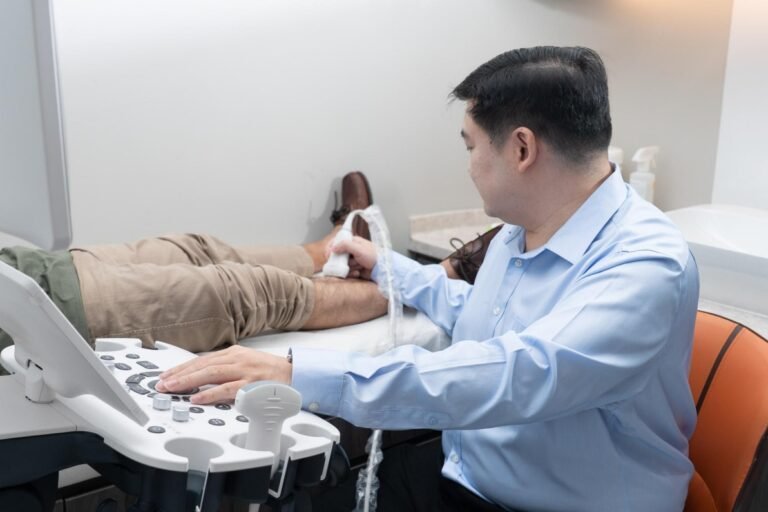
Chronic venous insufficiency is diagnosed with an examination of the legs and a duplex ultrasound scan, which shows the direction of blood flow in each vein.
A vein assessment usually includes these steps:
your symptoms, any previous blood clots, pregnancies, family history and daily routine.
Dr Tay checks for swelling, varicose veins, skin changes and wounds. He also records your CEAP class.
a painless scan, usually done while you stand, shows where valves leak and whether any vein is blocked. It also maps which veins could be treated.
the arteries are checked before strong compression is prescribed, to make sure blood flow into the leg is good.
in a small number of patients, a CT or MRI scan of the veins looks for a blockage higher up in the abdomen or pelvis.
Colour duplex ultrasound is the standard test for venous reflux, according to StatPearls. The scan results guide every treatment decision that follows.
Chronic venous insufficiency is treated by lowering the pressure in the leg veins. Most people start with compression and lifestyle measures, and minimally invasive procedures can close faulty veins when the scan shows reflux that can be treated.
The right plan depends on your CEAP class, your symptoms and which veins are affected. Not everyone with CVI needs a procedure.

Regular walking, raising your legs and caring for your skin help at every stage of CVI.
Simple daily habits include:

Graduated compression stockings squeeze the leg most at the ankle, which helps push blood upwards and reduces swelling. They are a first line treatment for CVI at every stage.
Your doctor chooses the pressure and length that suit your leg, after checking the arteries. For open ulcers, layered compression bandages may be used instead. You can read about the types and fitting of compression stockings.
Some patients take venoactive medication, such as Daflon, to ease heaviness, aching and swelling. Medication can relieve symptoms but does not repair leaking valves, so it is used alongside compression or procedures. Dr Tay will advise whether it suits you.
Open surgery, such as vein ligation and stripping, is used less often today but remains an option for some veins that are not suitable for endovenous treatment. It is done under anaesthesia and usually involves a longer recovery than endovenous procedures.
Venous leg ulcers heal with a combination of compression, careful wound care and treatment of the faulty veins underneath. Regular cleaning, suitable dressings and removal of dead tissue (debridement) support healing. Treating the underlying reflux aims to lower the chance of the ulcer coming back.
Our chronic wound care service manages leg ulcers alongside vein treatment.

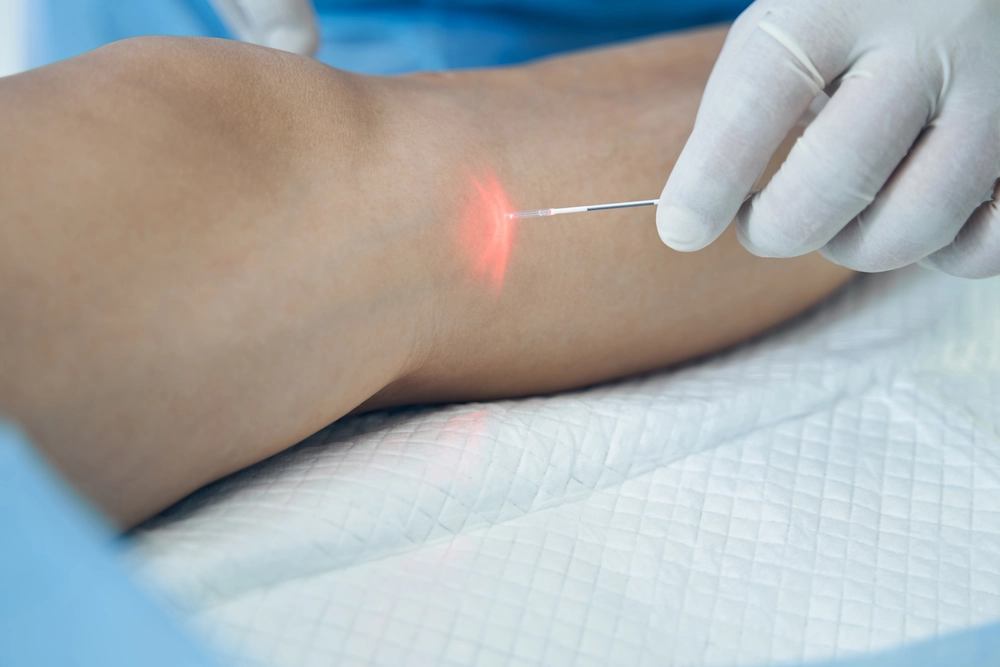
When the scan shows reflux in a superficial vein, the faulty vein can be closed from the inside so that blood reroutes through healthy veins.
These procedures are usually done as a day procedure under local anaesthetic, through a needle puncture in the skin. Options include:
Each technique suits different veins. Our page on varicose vein treatment options explains how they work and what recovery involves.
The table below summarises how treatment usually changes with severity.
| Stage | Main aims | Options often considered |
|---|---|---|
| C3: swelling | Reduce swelling and discomfort | Exercise, leg elevation, compression stockings, treatment of veins with reflux |
| C4: skin changes | Protect the skin and stop further damage | Skin care, compression, medication for symptoms, endovenous treatment of faulty veins |
| C5: healed ulcer | Prevent the ulcer from returning | Long term compression, treatment of faulty veins, regular follow up |
| C6: active ulcer | Heal the wound and prevent it returning | Compression bandaging, wound care, treatment of faulty veins |
Your treatment plan depends on your scan results and general health, and is discussed at your consultation.
Chronic venous insufficiency cannot usually be cured, because damaged vein valves do not repair themselves. Treatment can control symptoms, heal ulcers and slow the condition down.
Closing the faulty superficial veins removes the main source of reflux for many patients, and symptoms often improve. Other veins can become faulty over time, so CVI is managed as a long term condition with follow up. Staying active and wearing compression when advised remain part of care after a procedure for many people.
See a vascular specialist if leg swelling, heaviness or skin changes last for more than a few weeks, or if a wound near your ankle is slow to heal.
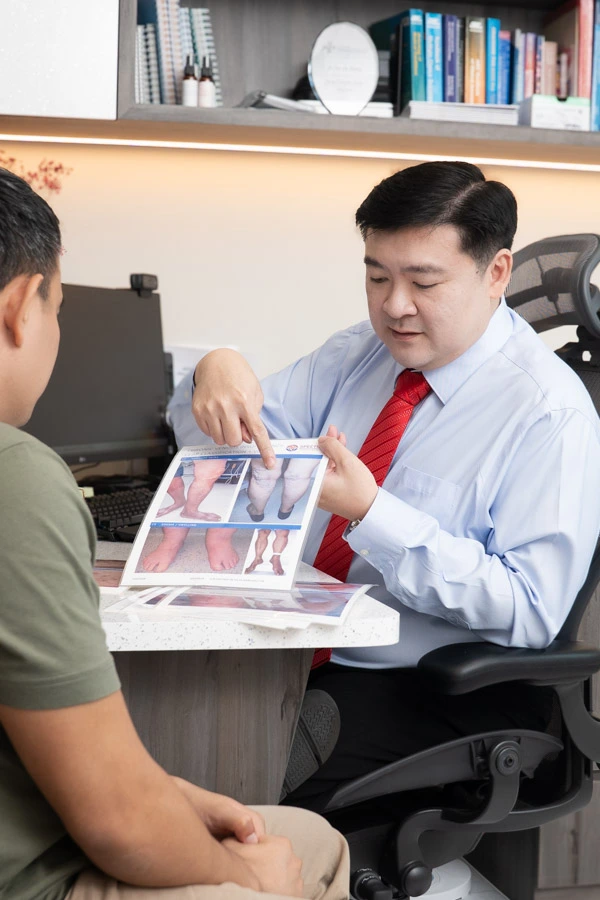
Dr Tay Jia Sheng is a Senior Consultant Vascular & Endovascular Surgeon with a special interest in minimally invasive endovenous surgery. He was the founding surgeon of the Vascular and Endovascular Service at Sengkang General Hospital. He sees patients at Mount Elizabeth Novena Specialist Centre and Farrer Park Hospital Medical Centre.
Dr Tay Jia Sheng is a Senior Consultant Vascular & Endovascular Surgeon with a special interest in minimally invasive endovenous surgery. He was the founding surgeon of the Vascular and Endovascular Service at Sengkang General Hospital. He sees patients at Mount Elizabeth Novena Specialist Centre and Farrer Park Hospital Medical Centre.
Chronic venous insufficiency is not usually life threatening. It can lead to skin damage, ulcers and infection if left untreated, so it is worth having assessed early.
Yes. Most people with CVI stay active and keep working, especially once symptoms are controlled with compression, exercise or treatment of faulty veins.
Yes. Walking works the calf muscle pump, which pushes blood out of the leg veins and can ease swelling and heaviness.
Most endovenous procedures are done under local anaesthetic, so patients usually feel pressure or mild discomfort. Dr Tay will explain what to expect for your treatment.
Treated veins usually stay closed, but other veins can develop reflux over time. Staying active, wearing compression when advised and attending follow up help to lower this risk.
Coverage depends on your insurance plan and whether treatment is medically necessary. Our clinic team can help you check what your policy or MediSave may cover before treatment.
For enquiries, consultation or second opinions, please complete the form below or call us at +65 8874 0371
Our team will get back to you shortly to assist with your request.

38 Irrawaddy Road
#10-33
Singapore 329563
Tel: +65 6041 0933
1 Farrer Park Station Road
#08-14 Connexion
Singapore 217562
Tel: +65 6974 8859
HP: +65 8874 0371 (24 hours)
Email: co*****@**************ry.com
© 2026 Spectrum Vascular & General Surgery
